An agency owner I know quoted a $12,000 website build last year, won the project, and lost money on it. Not because the build ran long. Because eighteen months later he was still absorbing the maintenance: plugin updates, a hacked staging site, three "quick change" requests a month that nobody was billing for. The project was profitable. The relationship wasn't.
That gap is what white-label web design is supposed to close, and it's why the term means something very different depending on who is using it.
What "white label" actually means in web design
The phrase covers three arrangements that get talked about as if they were one thing:
White-label services. You sell the project, another shop builds it, and their work ships under your name. You own the client relationship, they own the production. The margin is the spread between what you charge and what you pay them.
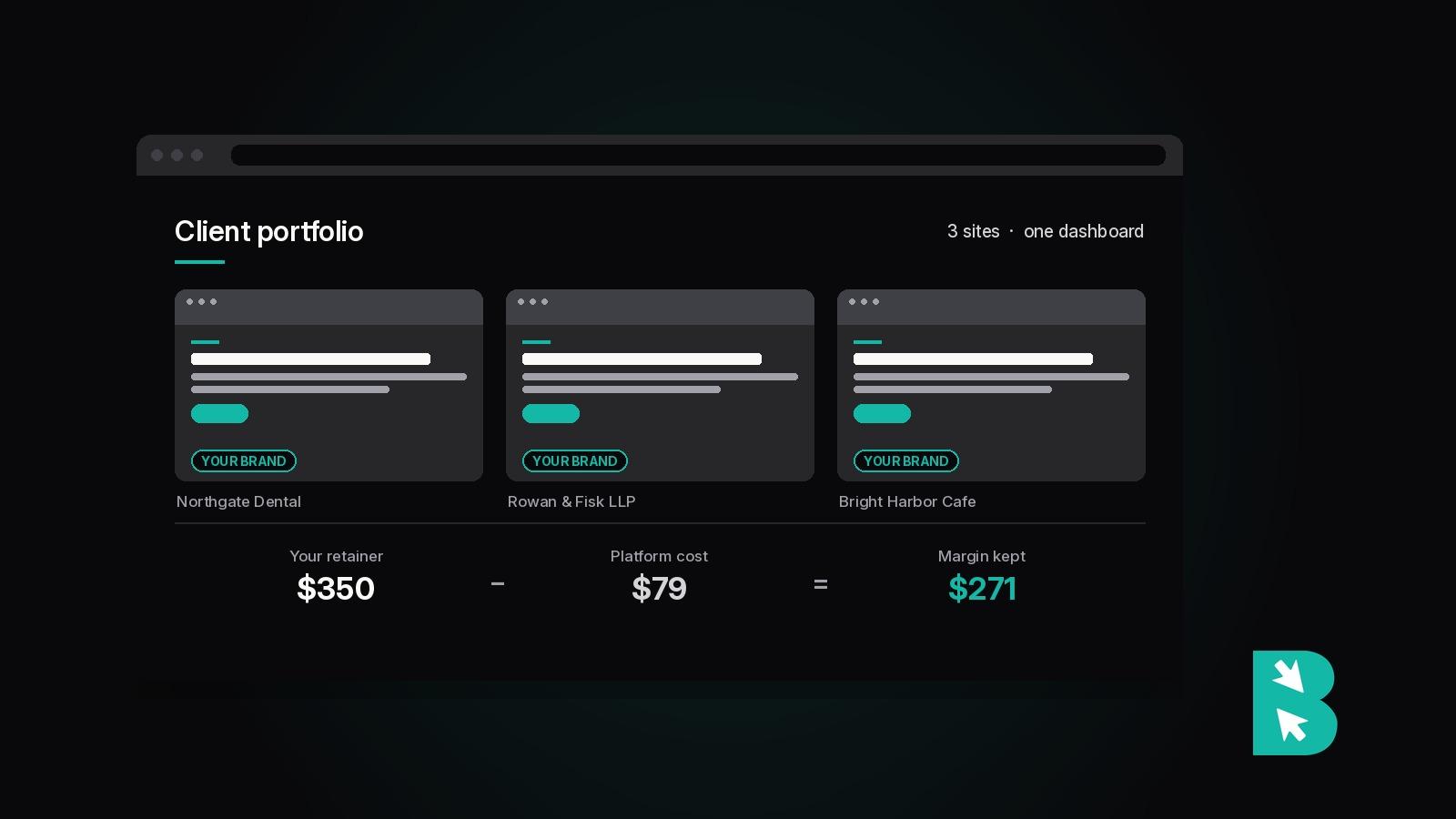
White-label platforms. You build on somebody else's software, and the client never sees the vendor's branding. Your logo in the admin, your domain on the dashboard, your name on the invoice. The margin is the spread between your retainer and the platform fee.
Reselling. You buy hosting or software wholesale and resell it at your own price, usually bundled into a care plan. Closest to pure arbitrage, and the thinnest margin of the three unless you're adding real service on top.
Most agencies end up doing some blend. The mistake is picking a model without pricing it first, which is how you end up like the guy above: profitable on paper, underwater in practice.
Where the margin actually leaks
Agency margin rarely dies in the build. It dies in the eighteen months after.
Run the arithmetic on a portfolio of twenty WordPress client sites. Each one carries plugin licenses, managed hosting, security and backup tooling. Call it conservatively $300 to $500 per site per year in pure vendor costs, and that's before a person touches anything. Twenty sites puts you at $6,000 to $10,000 a year in pass-through spend you're either eating or awkwardly line-iteming. We put real numbers on a single site's version of this in the real cost of WordPress maintenance.
Then there's the labor nobody quotes. Plugin update Tuesdays. The update that breaks a contact form and doesn't announce itself for three weeks. Version drift across twenty sites that were each built slightly differently by whoever was free that month. If a mid-level developer spends six hours a week on maintenance across the portfolio, that's roughly 300 hours a year. At a $75 internal cost, $22,500 in labor that generates no new revenue.
The reason this compounds is architectural. Every plugin is built by a different team, on a different release schedule, with different quality standards. WordPress core updates break plugins. Plugins break each other. There is no version of that portfolio where the number gets smaller as you add clients. It gets bigger, linearly, forever.
What to look for in a white-label platform
If you're evaluating platforms to standardize on, the questions that predict your margin two years out:
- What is the per-site cost, and is it fixed? A platform whose price moves with traffic or pageviews transfers your client's success into your cost line. Fixed per-site pricing is what lets you quote a care plan and keep the spread.
- How much is genuinely included? Hosting, SSL, backups, forms, analytics, session replay, and security bought separately is a stack of vendors, invoices, and failure points. Every one of those you fold into the platform is margin you keep and a support surface you delete.
- Can you manage every client from one place? Twenty logins is twenty chances to be locked out at the wrong moment. One dashboard across the portfolio is the difference between an hour of work and an afternoon.
- Is there an API or automation layer? The repetitive work across a portfolio (spinning up sites, pushing content changes, pulling reporting) is exactly the work that should not be manual at twenty sites.
- What does the client see? Some platforms let you rebrand the admin entirely. Others don't. Neither is disqualifying, but you should know before you're mid-pitch, not after.
- How do you get out? Ask what export looks like on the way in. A platform you cannot leave is a platform that can reprice you at will.
Pricing the care plan
The care plan is where white-label work becomes a business instead of a series of projects. The structure that holds up:
Take your true per-site cost, platform plus any pass-through vendors. Add the support hours you honestly expect, not the ones you hope for. Multiply by three. That's your floor.
The 3x is coverage. It absorbs the month a client needs six hours instead of one, it funds the account management that keeps them from churning, and it leaves actual profit. Agencies that price care plans at 1.5x their cost are running a break-even help desk and calling it recurring revenue.
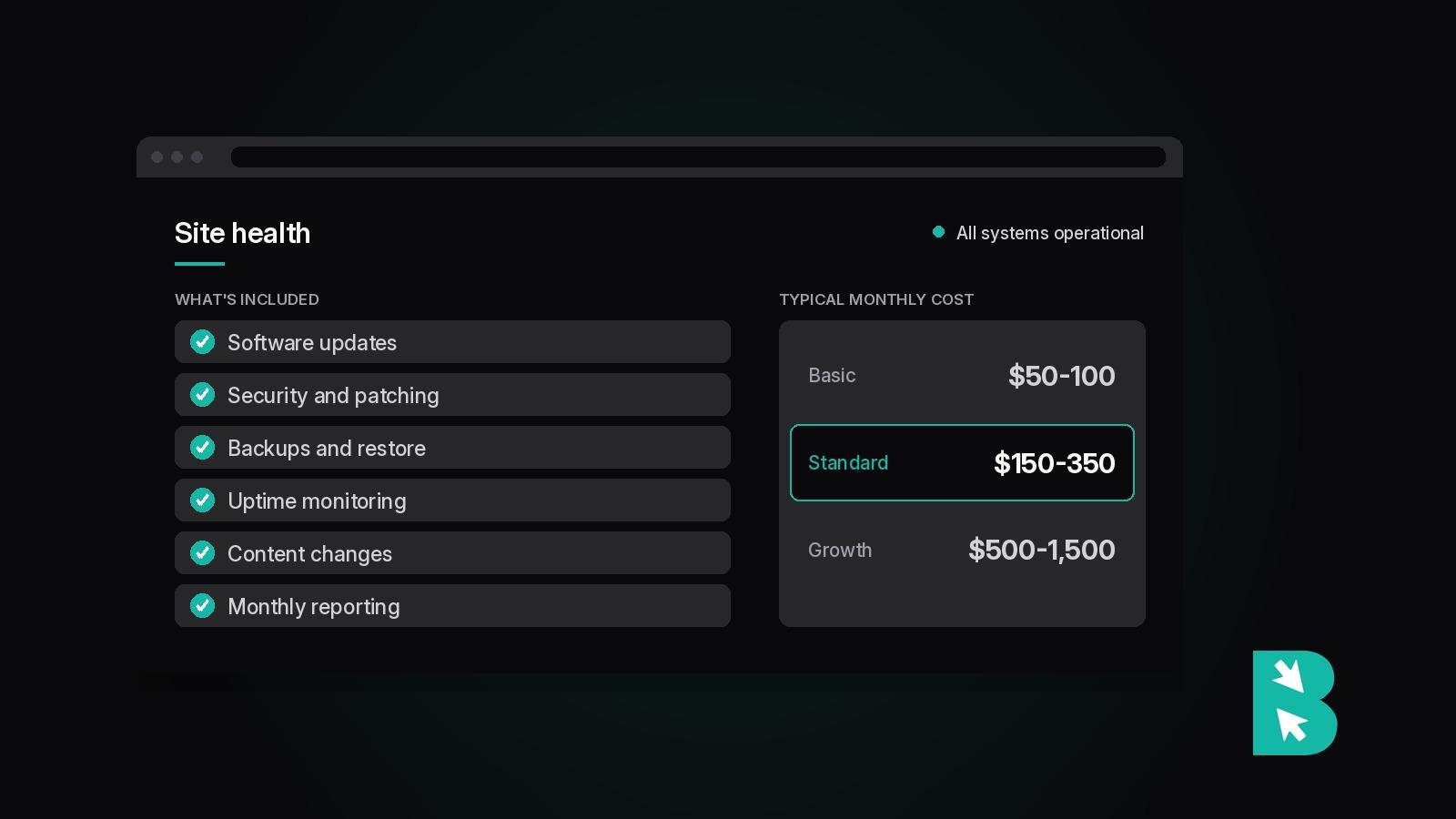
For what actually belongs in that plan, and the price bands the market is charging, see what a website maintenance plan should include.
The other move is to stop selling maintenance as maintenance. Nobody wants to buy plugin updates. They want to buy a site that keeps working, keeps getting found, and keeps producing leads. Same work, different invoice, and a much easier renewal conversation.
Where BrightSite fits, and where it doesn't
We built BrightSite partly because of the arithmetic above. Hosting, SSL, backups, security, forms, analytics, and session replay are included rather than assembled, which collapses the vendor stack into one line item. Pricing is fixed per site at $39, $79, or $149 a month, so a care plan quoted today still has the same cost basis when the client's traffic triples. Every client site lives in one dashboard, and there's a full MCP server and API for the portfolio-wide work you shouldn't be doing by hand.
There's also a partner program with volume pricing as your portfolio grows.
Now the honest part. BrightSite is not a fully rebrandable white-label platform today. You can put client sites on your own domains and manage them under your account, but we don't currently offer a fully reskinned admin with your logo in place of ours. If a completely vendor-invisible dashboard is a hard requirement for how you sell, that's a real gap and you should know it now rather than three calls in.
It's also the wrong tool for some work. Complex WooCommerce builds, sites that depend on a long tail of niche integrations, or a team with deep WordPress expertise and a maintenance process that genuinely works are all better served where they are. We're a fit for agencies who never wanted to be in the plugin maintenance business and are tired of that work quietly eating the margin on every retainer.
If that's the situation, the place to start is the arithmetic. Add up what your current portfolio costs per site per year, licenses, hosting, and the labor you don't bill for. Most agencies have never put that number on paper. It's usually the most persuasive thing in the room.